
When Your Dog Puts a Paw on Your Hand While You’re Petting Him
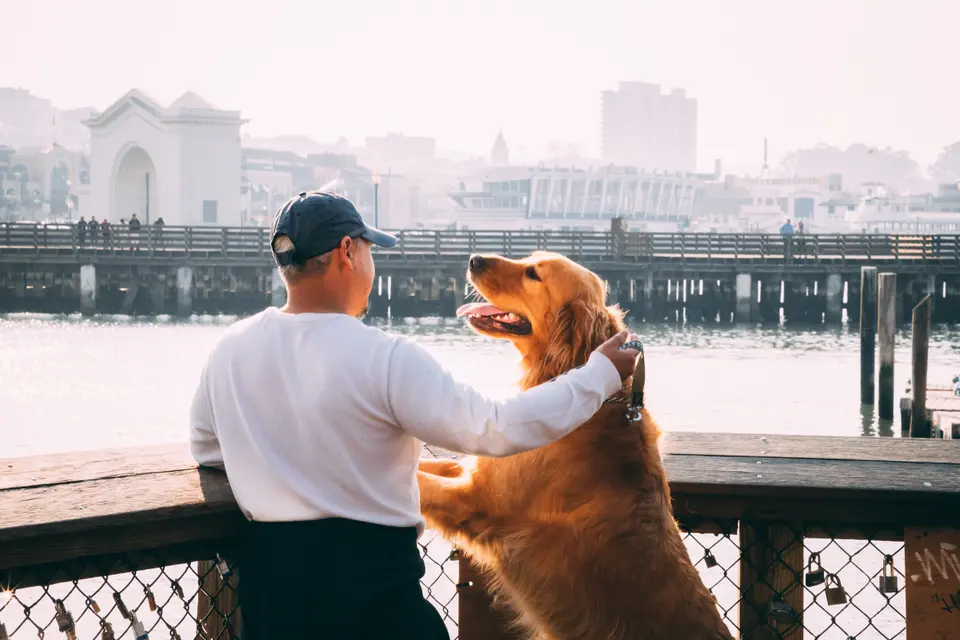
There is a certain kind of evening that belongs to dog people.
The house is finally quiet.
The dinner dishes are in the sink, or at least close enough to count as dealt with. The TV is on low in the living room. Somewhere outside, a car rolls slowly down the street. A porch light glows across the way. The day has loosened its grip.
And your dog is beside you on the couch.
Maybe he is not technically allowed on the couch.
Maybe the rule used to be “no dogs on the furniture,” back when you believed rules were stronger than a dog’s face. But now there is an old blanket folded over one cushion, and everyone pretends that makes it different.
Your dog is stretched out there, half asleep.
His eyes are almost closed.
His breathing has slowed.
His body, which spent the whole day following you from room to room, barking at delivery trucks, supervising the kitchen, guarding the front window, and conducting serious neighborhood scent research in the backyard, has finally gone soft.
You reach down and start petting him.
Slowly at first.
Behind the ears.
Along the neck.
Down the shoulder.
The familiar places.
The places that make him sigh.
At first, he does not move much. Maybe his eyes close a little more. Maybe his head gets heavier against the cushion. Maybe one paw twitches the way dogs do when they are comfortable but still pretending not to care too much.
Then, halfway through, just as you start to move your hand away, he lifts one paw.
Not fast.
Not hard.
Not like a slap.
He simply places it on the back of your hand.
Lightly.
As if he is pressing pause on the moment.
And you stop.
Of course you stop.
Because any dog person knows that tiny weight.
It is not a command exactly.
It is not a trick.
It is not “shake.”
It is not begging the way dogs beg at the dinner table, with their whole bodies full of hope and poor manners.
It is something softer than that.
A paw resting on your hand, almost shyly.
As if he is saying:
Wait.
Don’t stop yet.
Right there.
A little longer.
A friend of mine has a dog named Bailey, a medium-sized pit bull mix with a white chest, warm brown eyes, and the emotional subtlety of a love song wrapped in a bowling ball. Bailey is strong, silly, stubborn, and incredibly tender in the quiet hours of the day.
At the dog park, she runs like she has important appointments with every tennis ball in the county.
At home, she throws herself onto the couch like furniture was invented specifically for her recovery.
But at night, when the house settles and my friend sits beside her, Bailey becomes gentle.
She will rest her big square head on the couch cushion, close her eyes halfway, and wait.
My friend scratches the soft place behind her ears.
Bailey exhales.
Then the hand slows.
Bailey opens one eye.
The hand starts to leave.
And Bailey, with great seriousness, lifts one paw and places it over my friend’s wrist.
Not gripping.
Not grabbing.
Just holding.
My friend says it gets her every time.
Because Bailey cannot say, “I liked that.”
She cannot say, “That felt good.”
She cannot say, “I have had a long day of being a dog, and this is exactly what I needed.”
So she uses the language she has.
A paw.
A pause.
A little pressure.
That is one of the sweetest things about dogs. They do not have elegant ways to express affection. They cannot write notes. They cannot say thank you. They cannot explain that the world felt too loud today, but your hand on their shoulder made it quieter.
They use what they have.
They lean.
They sigh.
They scoot closer.
They lower their head onto your foot.
They turn their body so the best scratching spot is easier to reach.
They close their eyes.
They press their forehead into your palm.
They put one paw on your hand.
And somehow, all of that says enough.
Dogs are not always graceful about love.
Sometimes their affection comes with elbows, wet noses, heavy paws, and no understanding of personal space. A seventy-pound dog may decide he is a lap dog. A small dog may climb onto your chest and block your breathing with complete confidence. A shepherd mix may follow you into the bathroom because apparently emotional support has no boundaries. A golden retriever may bring you a toy so aggressively that it feels less like a gift and more like a business proposal.
But then there are moments like this.
A paw on your hand.
Quiet.
Awkward.
Perfect.
It is easy to laugh at it.
“Are you holding me hostage?”
“Do you want more pets?”
“Was I dismissed too early?”
And yes, maybe the answer is yes.
Many dogs learn that a paw gets attention. Dogs are excellent observers. If they put a paw on your hand and you laugh, keep petting, or say their name in that soft voice, they may remember. The paw becomes part of the routine.
But that does not make it meaningless.
A dog can learn what works and still be sincere.
Humans do that too.
We learn which words comfort people. We learn when to reach for someone’s hand. We learn that a small gesture can keep closeness from ending too soon.
Dogs learn the same thing in their own way.
The paw may mean, “More.”
It may mean, “Stay.”
It may mean, “I like this.”
It may mean, “You are my person, and I am not done being close to you.”
The meaning depends on the dog, the moment, and the rest of the body.
A relaxed dog with soft eyes, loose muscles, slow breathing, and a gentle paw is usually asking for connection.
A stiff dog pinning your hand, whale eye showing, mouth tight, body tense—that is different. That may mean the dog is uncomfortable, conflicted, or trying to control the interaction. As with all dog body language, context matters.
But the soft paw?
The one that arrives when your dog is half asleep and happy?
The one that makes you smile before you even think?
That one usually feels like what it is.
A request to keep going.
There is something deeply moving about being asked for affection by an animal who does not need to perform for it.
Your dog does not care whether your day was impressive.
He does not ask how productive you were.
He does not need you to be charming, successful, polished, or interesting.
At night, on the couch, he only knows that your hand is warm and familiar, and that the place behind his ears feels better when you are touching it.
That is enough.
Maybe that is why these small dog gestures stay with us.
They cut through everything complicated.
The bills.
The emails.
The traffic.
The appointments.
The worries we carry around the house and pretend not to.
Then a dog puts a paw on our hand, and for one second the whole world becomes very simple.
Stay here.
Touch me gently.
We are together.
There is no philosophy in it, at least not from the dog’s side. Bailey is not trying to teach a lesson about presence. She is not making a statement about modern loneliness or emotional connection. She is just a dog who likes being petted and does not want the good part to end.
But dogs often teach us things without meaning to.
They remind us that affection does not always need words.
That comfort can be physical and quiet.
That asking for love does not have to be dramatic.
That sometimes the most honest request in the world is a paw resting on the back of your hand.
Many dog owners know this exact feeling.
You are rubbing your dog’s chest, and his paw slowly lands on your forearm.
You scratch under his chin, and he reaches out as if to pull you back.
You pause to check your phone, and one paw appears on your wrist with silent judgment.
You are tired and distracted, and your dog reminds you, very gently, that the job is not finished.
Not the important job.
The petting.
The being there.
The part of the night where you belong to each other for a few quiet minutes.
It can become a ritual.
The old Lab who climbs onto the couch after dinner and puts his paw on your knee.
The little terrier mix who curls against your hip and taps your hand when you stop.
The senior beagle who no longer jumps well but still reaches out from his bed when you sit beside him.
The rescue dog who once flinched from touch and now, months later, places one careful paw over your fingers because he has learned your hands are safe.
That last one is different.
Anyone who has loved a cautious dog knows how much it means when they ask for touch.
A dog who used to move away but now leans in.
A dog who used to freeze but now sighs.
A dog who used to watch hands with suspicion but now places his own paw over one.
That is not just cute.
That is trust.
Trust does not always arrive as a dramatic breakthrough. Sometimes it comes quietly, in tiny increments, until one evening you realize the dog who once kept distance has decided to keep you close.
A paw on your hand can carry a whole history.
Of patience.
Of gentleness.
Of not forcing.
Of letting the dog choose.
Of earning the right to be asked for more.
That is why it matters how we respond.
When a dog asks gently, we can answer gently.
Keep petting if he wants it.
Pause if he seems overstimulated.
Let him move away if he wants space.
Respect the dog in front of you, not just the sweetness of the moment.
Because affection should still be a conversation.
Even with a dog.
Especially with a dog.
Some dogs love endless petting.
Some enjoy a few seconds and then need space.
Some like chest rubs but not head pats.
Some love ear scratches.
Some prefer leaning against you without too much hand movement.
Some dogs put a paw on you because they want more attention.
Others do it because they have learned it makes humans laugh.
And some simply like to touch you while you touch them, as if closeness feels better when it goes both ways.
There is no need to overanalyze every gesture.
But there is value in noticing.
Dogs spend their lives noticing us.
They know the sound of our car in the driveway.
They know which shoes mean a walk.
They know which cabinet holds the treats.
They know when our voices are tired.
They know when we are sad and trying to act normal.
They know when we are about to get up before we move.
It is only fair that we notice them too.
The little paw.
The half-closed eyes.
The long sigh.
The way the body softens.
The way the dog presses just a little closer when the world has gone quiet.
These are not grand gestures.
They are the small grammar of being loved by a dog.
And once you learn that language, you hear it everywhere.
In the paws clicking down the hallway to find you.
In the nose nudging your elbow while you work.
In the dog who waits outside the bathroom door.
In the warm body pressed against your legs on the couch.
In the paw that lands on your hand the moment you stop petting.
Bailey still does it.
Every evening, after dinner, she climbs onto her designated blanket on the couch. My friend sits down beside her. The TV comes on. The house settles.
Bailey closes her eyes.
The hand begins to move.
Behind the ears.
Along the neck.
Down the shoulder.
At some point, my friend gets distracted. The hand slows.
Bailey lifts her paw.
Places it gently on top.
And the whole conversation happens without a word.
Not done.
Stay.
A little longer.
So my friend stays.
Because really, who could refuse?
Not forever.
Not all night.
Just a few more minutes.
Sometimes that is all love asks for.
A few more minutes of being present.
A few more minutes of warmth.
A few more minutes where a dog does not need to understand human language to say exactly what he means.
So the next time your dog puts a paw on your hand while you are petting him, pause before you move away.
Look at his face.
Feel the weight of that small request.
Maybe he is asking for more scratches.
Maybe he is asking you not to stop yet.
Maybe he is simply saying, in the sweet, clumsy language of dogs:
This is good.
Stay here with me.
For families who understand these small, quiet ways pets communicate, travel is never just logistics. A dog or cat has routines, comforts, favorite people, familiar touch, and little ways of asking for reassurance. 0x Cargo Pet Travel helps California families with international pet transportation, planning overseas moves with care for pets who are not just animals, but beloved family members. Whether your pet is a confident traveler, a cautious rescue, a shepherd mix, a pit bull mix, a senior companion, or the dog who gently puts a paw on your hand when he wants you to stay, every journey deserves patience and attention. To learn more, visit 0xcargo.com or call 650-656-0082.