
Starting in 2026: U.S. → Hong Kong Dog & Cat Health Certificates (Continental U.S. Form) Can Be Digitally Signed and Digitally Endorsed—Owners Can Download and Print Directly From VEHCS
International pet travel paperwork is rarely “hard” because it is intellectually complex—it’s hard because it is time-sensitive and fragile. One missing stamp, one wrong date, one shipping delay, and suddenly the flight is still on schedule while your dog or cat is not.
For years, one of the most stressful steps for U.S. pet owners moving a cat or dog to Hong Kong was the endorsement bottleneck: even after your veterinarian completed the health certificate correctly, you still had to worry about the physical movement of documents—overnight courier shipments, return labels, weekend cutoffs, and the very real possibility that a critical envelope could be delayed or lost.
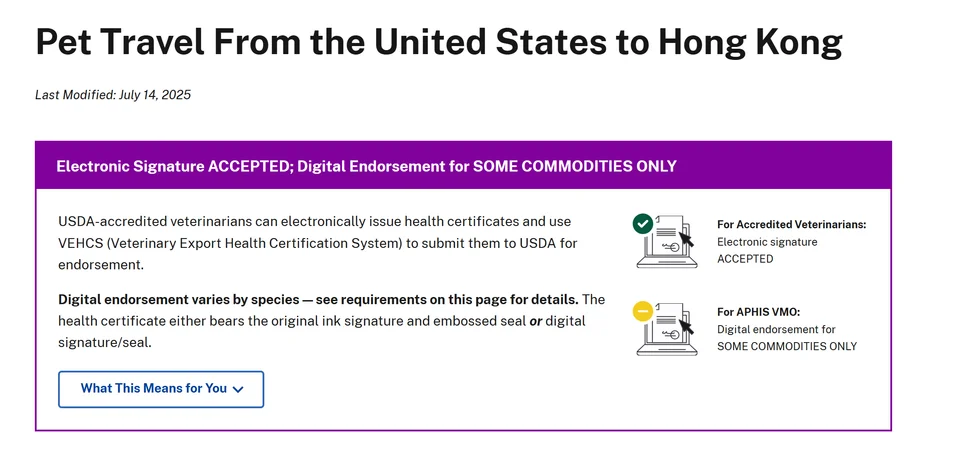
In 2026, there is a significant improvement for many U.S. → Hong Kong dog and cat travelers: for one specific certificate—the “Pet Dogs and Cats – From Continental U.S.” form—digital signature and digital USDA APHIS endorsement are accepted, and owners can print the endorsed health certificate directly from the Veterinary Export Health Certification System (VEHCS) rather than waiting for a paper certificate to be mailed back.
This blog explains:
- Exactly what is eligible for digital processing (and what is not)
- Why this reduces travel risk (shipping delays and fraud vulnerability)
- The current Hong Kong requirements for dogs and cats traveling from the United States, rewritten clearly: vaccines, timing, microchip, residency statements, minimum age, exam window, and import permit considerations
- How 0x Cargo Pet Travel can manage this process end-to-end
1) The Real Update: Digital Endorsement Is Accepted—But Only for a Specific Hong Kong Pet Certificate
USDA APHIS states that Hong Kong supports electronic signature for accredited veterinarians, and that digital endorsement varies by species/commodity.
For dog and cat travel, the key line on the USDA Hong Kong page is explicit:
For the “Pet Dogs and Cats – From Continental U.S.” certificate ONLY, digital signature by the USDA-accredited veterinarian and digital endorsement by USDA APHIS are accepted, and the health certificate can be generated through VEHCS.
This point matters operationally:
- Eligible: Pet Dogs and Cats – From Continental U.S. certificate (digital signature + digital endorsement accepted)
- Not automatically eligible: other Hong Kong pet commodities or other origin-specific forms may still require original ink endorsement and physical return shipping arrangements
So the right way to describe the change is:
- Hong Kong dog/cat exports from the continental U.S. now have a pathway that can be fully executed in VEHCS with digital signing and digital endorsement for that specific form—allowing owners to print their endorsed certificate directly.
2) What This Means for Pet Owners: Download and Print the Endorsed Certificate—No Waiting for a Mailed “Wet Ink” Original
USDA APHIS explains the practical effect in plain language under “What This Means for You”:
- Digitally endorsed health certificates can be printed directly from VEHCS.
- For non-digitally endorsed certificates, owners can arrange to have the endorsed certificate returned by mail (return label required).
- A paper version of the endorsed health certificate must accompany the animal during shipment or travel.
This is the functional change pet owners care about:
Before
Even if your paperwork was correct, your trip could still fail because the endorsed certificate was in transit.
Now (for the eligible Hong Kong dog/cat certificate)
Once endorsed digitally, you can print it immediately from VEHCS and proceed—without needing the USDA endorsement office to mail a paper certificate back to your home address.
This is not “paperless travel.” Hong Kong still requires a printed health certificate to travel with the pet. The difference is that the certificate’s return-to-owner step is no longer dependent on courier delivery for the eligible form.
3) Why This Matters: Two Advantages That Reduce Real-World Failure Rates
Advantage 1: You eliminate the “courier risk” that has derailed countless trips
When a health certificate is time-bound (as Hong Kong’s is—issued and endorsed close to departure), shipping risk becomes disproportionate:
- packages delayed by weather, holiday volume, or regional disruptions
- misrouted envelopes
- missed delivery windows
- “delivered” scans with no envelope in hand
Under the Hong Kong guidance, endorsement is still required for pet dogs and cats and must occur within the departure timeframe, which is precisely why shipping delays historically caused so much stress.
By allowing owners to print the endorsed certificate directly from VEHCS for the continental U.S. dog/cat form, the most failure-prone leg of the chain—document return shipping—can be removed.
Advantage 2: Digital issuance and endorsement strengthens verifiability and reduces forgery incentives
You mentioned a long-standing problem in international pet travel: forged health certificates and vaccine records.
The USDA’s framing supports the underlying mechanism: VEHCS is APHIS’ secure online system for creating, issuing, submitting, and endorsing export health certificates.
In addition, USDA provides a VEHCS Certificate Viewer specifically described as a tool “used to authenticate United States federal export certificates.”
That does not mean fraud becomes impossible, and it does not require assuming any specific “system-to-system integration” between jurisdictions. The practical conclusion is simpler and defensible:
- When certificates are issued and endorsed inside a government system and can be authenticated electronically, it becomes materially harder for bad actors to rely on low-effort paper forgery schemes, and it becomes easier for stakeholders to validate what was truly endorsed.
4) The Non-Negotiable Reminder: A Printed Endorsed Certificate Still Must Travel With Your Pet
Even with digital endorsement, USDA APHIS is clear:
- You must carry a paper version of the endorsed health certificate with the animal during shipment/travel.
So the new best practice is:
- Digitally endorsed → print immediately → protect the hard copy (use a document sleeve, keep duplicates in separate bags, and keep a scanned backup for your own reference).
5) Updated U.S. → Hong Kong Requirements for Dogs and Cats (Continental U.S. Certificate)
Below is a clean rewrite of the requirements embedded in the USDA-posted “Veterinary Health Certificate for Export of Dog or Cat (Continental USA) … to Hong Kong” form.
A) Microchip requirement
The accredited veterinarian must certify:
- They have verified the microchip number is accurate.
Practical note: microchip number consistency is one of the most common failure points. Ensure the microchip number matches across:
- the health certificate
- rabies certificate(s)
- core vaccine record(s)
- import permit / consignee documents
B) Residency and local rabies status statement (180-day framework)
The veterinarian must certify that the animal has:
- been continuously residing in the country/place of export during the preceding 180 days (or since birth), and
- the area within 10 km of the animal premises has been free of reported rabies cases in any animals (excluding bats) during the preceding 180 days from the date of departure.
This is an important operational requirement because it ties eligibility to geographic history, not just vaccination.
C) Rabies vaccination timing and documentation
The form requires:
- rabies vaccination less than 1 year and more than 30 days prior to departure
- if it is a primary vaccination, the animal must have been at least 90 days old at vaccination
- a copy of the history of all rabies vaccination records must be attached
This means owners should plan rabies timing intentionally. If your pet’s rabies shot is expiring too soon, do not wait until the last minute and risk falling inside the “less than 30 days” window.
D) Core vaccines (non-rabies) timing and documentation
The form requires that the animal has been vaccinated against core diseases:
- Dogs: canine distemper, infectious canine hepatitis, canine parvovirus
- Cats: feline panleukopenia (feline infectious enteritis) and feline respiratory disease complex including feline herpesvirus & feline calicivirus
- Timing: not less than 14 days and not more than 1 year before coming into Hong Kong
- Documentation: vaccination records must be attached
E) Health status at exam
The veterinarian must certify:
- the animal is free from clinical signs of infectious/contagious disease and fit to travel to Hong Kong
- the animal is not under quarantine restrictions in the exporting jurisdiction
F) Pregnancy status (for females)
The form includes a reproductive status statement:
- the animal is either not pregnant, or less than 4 weeks pregnant if female.
G) Minimum age at export
The certificate explicitly states:
- the animal must be at least five (5) months of age at the time of export.
This is a hard stop requirement; it affects planning for puppies and kittens.
H) 180-day residence at place of origin
In addition to the general residency statement, the certificate requires:
- continuous residence at the Place of Origin listed on the form for the 180 days prior to export, or since birth until export.
I) Import permit / Special Permit alignment (consignee matching)
The veterinarian must certify they have:
- reviewed the Special Permit issued by Hong Kong’s Agriculture, Fisheries and Conservation Department (AFCD) and verified the consignee name/address match the health certificate.
This is why “paperwork correctness” is not only about vaccines; it is also about identity alignment across documents.
6) Timing Window: Health Certificate Issuance and Endorsement Near Departure
USDA APHIS notes that for Hong Kong pet dogs and cats:
- endorsement is required after issuance by a USDA-accredited veterinarian within 14 days of departure (as framed on the Hong Kong requirements page and its PDF).
This is exactly why the shift to print-from-VEHCS is valuable: when the certificate window is tight, shipping delays become disproportionately dangerous.
7) The Practical “2026 Workflow” for Eligible Hong Kong Dog/Cat Certificates
A realistic compliance workflow looks like this:
- Plan backward from flight date (Hong Kong certificate is close-in timing)
- Ensure microchip and vaccination records are complete and readable
- Obtain/confirm the Hong Kong AFCD import permit (Special Permit) and consignee details
- Schedule the final exam and certificate issuance within the required window
- Vet issues and submits via VEHCS for USDA APHIS endorsement
- Once endorsed digitally, owner prints from VEHCS
- Travel with the printed endorsed certificate and required attachments
USDA’s own language supports the key mechanics: digital certificates can be printed from VEHCS when digitally endorsed; non-digital certificates require mailing arrangements.
8) Common Mistakes That Still Cause Denials or Delays (Even With Digital Endorsement)
Digital endorsement reduces shipping risk—but it does not forgive compliance errors. The most frequent problems we see are:
- Wrong certificate type (digital endorsement accepted only for the continental U.S. dog/cat certificate)
- Microchip number inconsistency across vaccine records and certificate
- Rabies vaccine timing inside the “more than 30 days” rule or outside the “less than 1 year” rule
- Missing attachment: rabies vaccine history or core vaccine history
- Consignee mismatch between AFCD permit and health certificate
- Pet age under 5 months
Digital processing helps you move faster. It also means mistakes can surface closer to travel if you are not disciplined.
9) Where 0x Cargo Pet Travel Comes In (and Why It’s Worth It for Hong Kong)
Hong Kong is not “difficult” because the rules are impossible; it’s difficult because success depends on precision across:
- timing windows
- document alignment
- correct certificate selection
- correct attachments
- consignee/permit consistency
- airline operational requirements (crate rules, embargoes, acceptance windows)
0x Cargo Pet Travel supports U.S. → Hong Kong pet relocations with a compliance-first process:
- Vet coordination (USDA-accredited vet workflows aligned to the correct Hong Kong certificate)
- Timeline planning around the 14-day issuance/endorsement window
- Document audits (microchip and vaccine record consistency, attachment completeness)
- VEHCS readiness and print-from-system guidance when the commodity supports digital endorsement
- Risk reduction planning so that travel is not dependent on courier delivery
If your goal is a relocation that is predictable and defensible at inspection—not a last-week scramble—0x Cargo can manage the entire process from the first compliance timeline through the final printed certificate packet.