
Australia’s 2022–2026 Dog Import Rule Change: Ehrlichia canis (E. canis) No Longer Must Test “Negative” — The Date, the Reason, and What It Means for Real Families
A story that still haunts rescue and relocation communities: “Cinta”
In 2015, a pet owner adopted a dog in Vietnam and named her Cinta. By all accounts, she bonded deeply with her adopter. When the owner later prepared to return to Australia, he did what responsible adopters do: he saved for months, arranged veterinary checks, and tried to navigate one of the world’s strictest pet import frameworks.
Then the lab result landed: Ehrlichia canis positive.
At the time, Australia’s dog import conditions required dogs to be tested and found negative for E. canis using serology (IFAT). The owner appealed, waited, tried treatments, and tried again—because he believed love and persistence should count for something.
But the science is cruel in a very specific way: antibodies can remain detectable long after infection is cleared, which means a dog can be clinically healthy yet continue to test seropositive. In many cases, a “positive antibody test” tells you exposure happened—not that the dog is currently contagious, currently ill, or currently unsafe.
After nearly a year of trying, the owner gave up. Cinta stayed behind. In the retelling of the story shared within rescue circles, she declined soon after, as if the separation broke something essential.
Whether every detail of Cinta’s story is documented publicly or not, the underlying pattern is real and repeatable: a policy built around serology could permanently strand dogs who were otherwise healthy and loved, because the test outcome was sometimes more reflective of immune memory than of biosecurity risk.
Australia eventually changed that rule.
The key date: When did Australia remove the “E. canis must be negative” requirement?
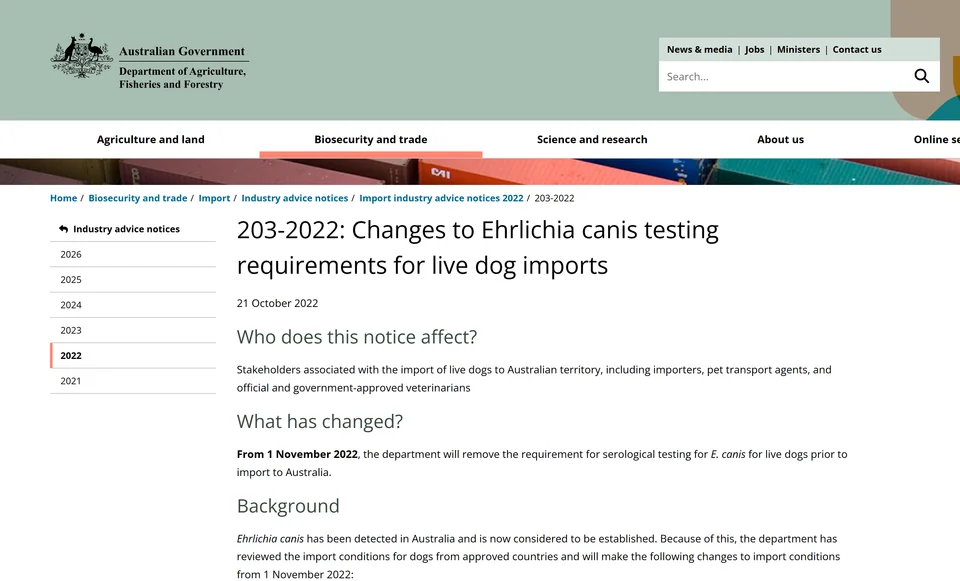
Australia’s Department of Agriculture (biosecurity) formally announced that it would remove the requirement for pre-export serological testing for Ehrlichia canis for live dogs effective 1 November 2022.
This was not a minor administrative tweak. It was a recognition that the old approach was no longer proportionate—scientifically, operationally, or ethically.
What exactly changed?
Before 1 November 2022
Import conditions for dogs entering Australia required dogs to be tested and found negative for E. canis via serology (IFAT). In late 2021, Australia acknowledged that the system was creating hard cases and stated it would assess applications to vary import permits for dogs that couldn’t comply because of a positive IFAT.
From 1 November 2022 onward
Australia removed the pre-export E. canis serology requirement for all dogs, including assistance dogs and service animals, under its revised import conditions.
Australia’s own policy update also notes explicitly that the change is tied to the pathogen becoming established domestically: import conditions for canine monocytic ehrlichiosis were removed in 2022 due to establishment of E. canis in Australia.
Why Australia changed the rule: the real “cause” is both epidemiology and test science
Australia’s rationale, as stated in government notices, includes:
- E. canis was detected in Australia in 2020 and is considered established, so the department reviewed import conditions and removed the pre-export serology requirement.
- The department also referenced international trading obligations in explaining why the requirement would be removed.
Those are the policy-level reasons. But to understand why the old rule became untenable, you need to understand what serology is—and what it is not.
Serology problem #1: Antibodies can persist “after the threat is gone”
Veterinary and public-health references agree on a core point: antibody tests can remain positive for months to years after infection, even after clinical recovery. A classic experimental study found most dogs remained seropositive long after infection (documented out to 34 months in that work).
So if a regulation treats “seropositive” as “unacceptable forever,” it effectively creates a lifetime ban for some dogs—regardless of treatment, current health status, or whether the dog is actively infected.
Serology problem #2: A positive test often indicates exposure, not import risk
Clinical guidance emphasizes that antibodies alone do not necessarily indicate an active infection requiring treatment or that the animal is a biosecurity threat. In other words, “seropositive” is not equivalent to “dangerous.”
Epidemiology problem: Once established domestically, import serology no longer buys what it used to
Australia first detected E. canis in 2020, after decades of believing the country was free of it. With the organism established and spreading across northern regions, the marginal benefit of blocking seropositive dogs at the border (especially via a test that reflects exposure) becomes harder to justify as a primary risk control.
What happened “as a result” of the change: winners, trade-offs, and what did NOT become easier
Result #1: Many dogs previously stranded by seropositivity became importable again
This is the most human outcome: families, adopters, and rescuers who faced a permanent “no” because of antibody persistence suddenly had a viable pathway—assuming all other Australian import requirements were met.
For owners of dogs from tropical and subtropical regions where E. canis exposure is common, this was not just a convenience. It was a reversal of a rule that often functioned as an emotional dead end.
Result #2: Australia did not “give up” biosecurity—control emphasis shifted
Australia did not remove external parasite controls. In fact, the government notice underscores that pre-export veterinary examination and treatment for external parasites remains and contributes to managing multiple diseases of biosecurity concern.
This is the logical substitute: if E. canis is tick-borne, then tick prevention and tick control are a more directly relevant risk lever than a blanket serology gate.
Result #3: Some requirements moved to protect Australia’s external territories
The 2022 change also included an important nuance: while Australia removed E. canis serology for dogs entering Australian territory broadly, it added pre-export E. canis serology requirements for movement of dogs from the Australian mainland to Norfolk, Christmas and Cocos Islands. That is classic risk management: national establishment changes the calculus for the mainland, while island biosecurity often demands tighter controls.
Result #4: The broader Australia import system remains strict—and still requires long lead times
Owners sometimes hear “one test removed” and assume “Australia is easier now.” It isn’t. Australia still has one of the most demanding pet import frameworks globally, including permit logic, rabies vaccination sequencing, RNATT timelines for dogs/cats from certain groups, and mandatory post-arrival quarantine procedures in Melbourne for many pathways.
The change is best understood as one important friction point removed—not an overall relaxation of standards.
A clearer explanation for pet owners: why “E. canis positive forever” was a predictable trap
Cinta’s story resonates because it sits at the intersection of policy and immunology:
- Serology measures immune response, not necessarily active disease.
- Antibody persistence can be long—sometimes years—so a dog can be healthy while still testing positive.
- An import regime that requires “seronegative” becomes, for some dogs, a permanent wall.
This is exactly why many modern disease-control programs increasingly rely on risk-based approaches: combine tick control, clinical exams, targeted diagnostics (when appropriate), and post-arrival monitoring—rather than treating seropositivity as a permanent disqualifier.
Practical takeaway: If you are planning an Australia import in 2026, what should you do differently?
Even though E. canis serology is removed, Australia remains a “calendar discipline” destination. Here is the disciplined way to plan:
- Start early — Australia timelines are rarely compatible with “last-minute moves.”
- Prioritize parasite prevention — because tick-borne risks don’t disappear just because one lab requirement does.
- Keep documentation clean and auditable — Australia’s system is procedural; inconsistencies create delays.
- Do not assume internet summaries are current — even large pet relocation websites sometimes repeat outdated requirements; always anchor to Australian government notices and BICON changes.
The 2022 policy change is a good example: many unofficial guides continued to list the E. canis negative test requirement long after it was removed.
Where 0x Cargo Pet Travel fits: compliance architecture, not “paper pushing”
If you are relocating a dog or cat to Australia, the work is not only veterinary—it is also logistics, scheduling, and document governance. 0x Cargo Pet Travel supports Australia-bound relocations by:
- building a backward timeline from intended departure
- coordinating with government-approved / accredited veterinarians on the exact sequencing
- preventing “single-point-of-failure” issues (expired windows, mismatched IDs, missing attachments)
- managing compliance changes as they occur (e.g., rule updates like the E. canis change effective 1 Nov 2022)
If your pet has a complex medical or geographic history—rescues, long residency in endemic regions, multiple country stays—professional compliance planning is often the difference between a successful import and months of wasted time.
Closing: Cinta’s lesson, and why this change matters
Australia removed the E. canis serology requirement effective 1 November 2022 because the disease became established domestically and because a “seronegative-or-nothing” rule is a blunt instrument in a world where antibodies can persist long after infection.
For many owners, that change means something simple but profound: a dog should not be permanently separated from its family because its immune system remembers an old exposure.
If you want help translating policy into a workable, step-by-step Australia relocation plan—especially for rescued dogs or dogs with complicated medical histories—0x Cargo Pet Travel can manage the full compliance workflow so your move does not hinge on guesswork.