
2026 Pet Air Travel Reality Check: Why Your “Old Crate That Worked Last Time” Can Get Rejected This Time (And How to Avoid a Day-of-Flight Disaster)
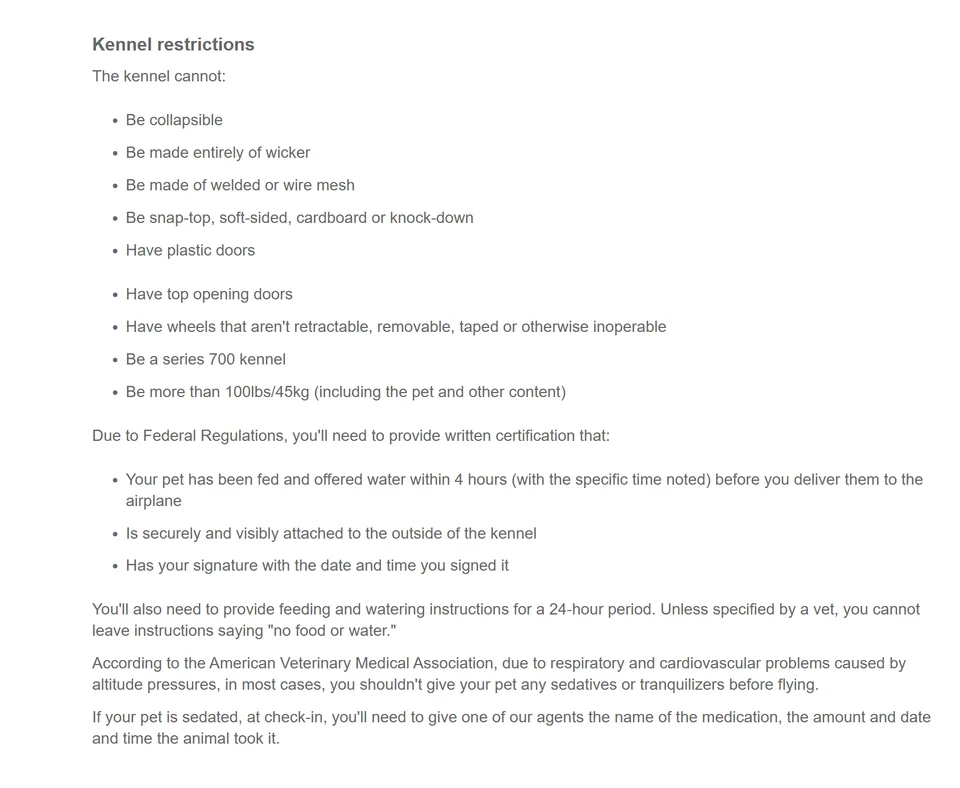
If you have shipped a dog or cat by air before, it’s natural to assume you can reuse the same crate. It feels efficient. It feels familiar. And it feels like a “known good” solution.
In 2026, that assumption is one of the fastest ways to lose a flight.
Not because airlines are trying to be difficult—but because the industry has moved toward tighter welfare standards and tighter enforcement. The modern reality is simple:
- Many airlines now require crates that meet current IATA Live Animals Regulations and reserve the right to refuse any container that doesn’t comply.
- The requirements are no longer treated as “general guidance.” They are increasingly treated as measurable, checkable specifications—vent openings measured in millimeters, fastening rules, and sizing formulas tied to the animal’s dimensions.
So yes: your crate may have “worked last time.” That does not mean it will be accepted next time.
This article explains the three main reasons crates get rejected in 2026—and gives you a practical checklist and solution path that prevents the painful scenario of standing at the cargo desk with a pet who is ready to travel… and a crate that is not.
The 2026 Rule-of-Thumb
If your pet will travel in the hold as checked baggage or air cargo, assume the airline will enforce all of the following:
- Your pet must be able to stand, move, turn, and lie down in a natural position—and the crate must be sized accordingly.
- Crate design must meet current IATA LAR container requirements, including fasteners, ventilation design, and “nose and paw proof” openings.
- Acceptance is at the operator’s discretion—meaning “IATA compliant” marketing language from a manufacturer is not a boarding guarantee.
With that in mind, let’s unpack the three big “why did they reject my crate?” reasons.
Reason #1: Your Pet Changed (Even If You Didn’t Notice)
This one is obvious, but it’s also the most common.
Pets grow. Pets bulk up. Pets broaden.
A crate that fit a 9-month-old German Shepherd may be unacceptable for that same dog at 18 months—even if the dog “looks about the same” to you.
Airline and IATA frameworks are ultimately concerned with functional posture:
- Can the pet stand without touching the ceiling (with bedding included)?
- Can the pet turn around normally?
- Can the pet lie down naturally?
IATA’s container guidance explicitly ties crate dimensions to the animal’s measurements and even notes that bedding height must be included when calculating internal height. Lufthansa states the container dimensions must allow the animal to stand, move, and lie down in its natural position—and warns they can refuse non-compliant containers.
Why “It Fit Before” Doesn’t Matter
Because last time’s acceptance didn’t necessarily include strict measurement or strict welfare enforcement at the counter. In 2026, many carriers and animal reception centers are far less flexible—especially on long-haul and international cargo moves.
Actionable check: If you haven’t measured your pet within the last 30–60 days (especially for young dogs, large breeds, and pets that have gained weight), treat your old crate as unverified.
Reason #2: Even If Your Pet Didn’t Change, Airlines Are Enforcing More Explicit Welfare Sizing Rules
This is the part that surprises experienced travelers.
In prior years, some airlines’ real-world enforcement was inconsistent. People got away with “close enough” sizing—especially if the animal was calm and could physically fit inside the crate.
That is increasingly not the case.
“Close Enough” is being replaced by “Meets the measurement standard”
Modern standards are written in ways that can be verified:
- Minimum internal container dimensions can be calculated from the animal’s body measurements (length/width/height).
- Ventilation percentage is specified (e.g., IATA mentions a 16% ventilation standard in certain contexts; Heathrow’s Animal Reception Centre also specifies minimum ventilation and “nose and paw proof” design).
- Some facilities explicitly define ventilation opening requirements and mesh/bar thickness standards.
When standards become measurable, enforcement becomes binary.
What people experience at check-in
Your statement about airlines using rulers is directionally accurate in outcome, even if the exact procedure varies by airline and station. It’s not unusual for staff to evaluate:
- Animal posture inside the crate
- Crate height relative to the pet
- Internal length and turning space
- Ventilation design and safety (nose/paw proof)
Facilities like Heathrow’s Animal Reception Centre publish explicit container acceptance rules, including ventilation percentage, mesh thickness, and “nose and paw proof” requirements—illustrating the level of detail that can be enforced in practice.
The practical takeaway is not “every airline measures with a ruler.” The practical takeaway is: you should assume they can, and you should prepare as if they will.
Reason #3: Crate Design Rules Have Tightened—And Enforcement Now Targets Small Details
In 2026, many rejections are not about crate size—they’re about crate construction.
A) Ventilation openings: not just “has vents,” but “vents meet a maximum opening size”
IATA’s CR-1 container requirement (Edition 51, January 2025) states:
- All openings must be “nose and paw proof.”
- Openings must be a maximum of 25 mm x 25 mm (1 in x 1 in) for dogs and 19 mm x 19 mm (¾ in x ¾ in) for cats (and may need to be smaller to be nose/paw proof).
Lufthansa publishes essentially the same maximum vent size limits (25 mm for dogs, 19 mm for cats) and explicitly notes vents must be small enough or covered to prevent any body part protruding and injury risk.
What changed in practice:Old crates with wide “stylized” vents, large decorative cutouts, or unprotected openings may be rejected even if the crate is otherwise sturdy.
B) Fasteners: “plastic clips” are a growing rejection trigger
Lufthansa explicitly states that containers must be secured with metal screws, and that a plastic locking mechanism is not considered secure enough and will not be accepted.
IATA CR-1 also stresses secure assembly and appropriate construction to prevent the animal from compromising the container.
What changed in practice:Crates that rely on snap-locks or plastic twist fasteners—especially on larger sizes—are more likely to be refused by airlines that have moved to strict “bolt-together” expectations.
C) Door construction and integrity: “flimsy plastic doors” are no longer tolerated
IATA CR-1 states the door must be constructed of materials of sufficient thickness so the animal cannot bend or distort it.
Even where plastic doors may be technically allowed in some designs, the direction of travel is clear: airlines are prioritizing doors and hardware that will not fail under stress.
D) “Foldable,” “collapsible,” “two-door,” or modified crates: increasingly high-risk
In the past, some airports “looked the other way” on:
- Collapsible crates
- Crates with unconventional opening designs
- Home-modified ventilation panels
- Plastic windows or add-on panels
In 2026, you should assume the opposite: if the crate deviates from typical rigid IATA-style construction, it becomes a rejection risk—especially when enforcement is strict on vent opening geometry and secure fasteners.
This is also where travelers get burned by “but the manufacturer said it’s IATA compliant.”
The “IATA Compliant” Label Trap: Why the Manufacturer’s Tag Is Not a Guarantee
Many crates are marketed as “IATA compliant.” Sometimes the tag even looks official.
The problem is not that manufacturers are always lying. The problem is that:
- IATA LAR is a standard, but airlines (operators) apply it with discretion and additional requirements.
- IATA itself notes acceptability can be at the operator’s discretion, especially for certain container types.
- Airlines can refuse carriage if the container does not meet current IATA regulations or their own published requirements.
That’s why you often see fine-print disclaimers like “confirm with your airline.” And that disclaimer is not decorative—it is the legal and practical reality.
In 2026, the only crate that matters is the crate your airline will accept on that day, on that route, under that airline’s enforcement.
A Practical 2026 Checklist: How to Verify Your Old Crate (Before You Book Flights)
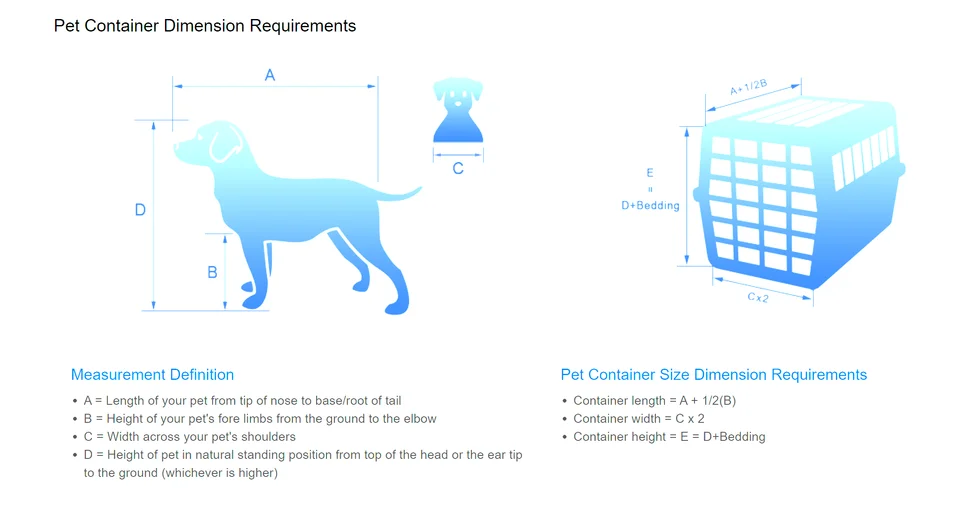
Step 1 — Measure your pet like the airline will
Use a tape measure and record:
- A (length): nose to base of tail (not the tail tip)
- B (height): floor to top of head/ears (depending on posture used)
- C (width): shoulder width / widest point
IATA CR-1 provides formulas to calculate minimum internal crate dimensions and notes bedding height must be included in height calculations.
If you do not measure, you are guessing. In 2026, guessing is expensive.
Step 2 — Compare pet measurements to internal crate dimensions (not the advertised “size”)
Crate manufacturers often quote external dimensions. Airlines and welfare rules are functionally about internal usable space.
Also remember: bedding reduces usable height. IATA explicitly tells you to add bedding height to the animal’s height when calculating minimum container height.
Step 3 — Inspect the crate design against current “hot buttons”
Use this design audit:
- Fasteners: Are top and bottom secured with metal bolts/screws (not plastic clips)?
- Ventilation: Are there vents on all required sides, and are openings nose/paw proof and within max opening size guidelines?
- Door integrity: Can the door be bent or distorted? (IATA requires door construction that prevents distortion by the animal.)
- Wheels: If present, can they be removed or rendered inoperable? (IATA and Lufthansa both address wheel restrictions.)
- Spacers/handles: Does the crate have spacer bars/handles so vents won’t be blocked by adjacent cargo? (Explicitly referenced in airline guidance.)
Step 4 — Do not assume “airport staff will let it slide”
Some facilities publish strict container requirements, including ventilation percentage and mesh thickness standards. If your route touches a strict station, your acceptance risk rises.
What To Do If Your Crate Fails One Item
There are three typical outcomes:
Outcome A — Minor modifications can make it compliant
Examples (depending on airline and crate design):
- Adding welded wire mesh to reduce vent opening size (while maintaining ventilation)
- Replacing plastic fasteners with metal bolts where the crate design supports it
- Adding appropriate spacers / handles
- Reinforcing door hardware (when permitted)
Be careful: “DIY modifications” can also backfire if they introduce sharp edges, reduce structural integrity, or create new protrusions—exactly what IATA warns against.
Outcome B — The crate is fundamentally the wrong design
Common cases:
- Collapsible/folding crates intended for cars or home use
- Crates with large decorative vents that can’t be made nose/paw proof without destroying airflow
- Crates that cannot be bolted together with metal screws
- Crates that are too low internally and cannot be “fixed” without upsizing
Outcome C — You need to replace the crate with a verified model
This is often the most cost-effective route when the travel date is near. The “cheapest crate” becomes very expensive when it causes a missed flight.
The Cleanest Solution: Contact 0x Cargo Before You Buy (or Reuse) a Crate
Here is the reality of 2026 pet logistics: the crate decision is no longer a simple Amazon purchase. It is a compliance decision.
The smartest timing is before you spend money.
When you contact 0x Cargo Pet Travel early—ideally before crate purchase—we can:
-
Evaluate your existing crate (photos + measurements) against current airline enforcement trends and IATA LAR construction expectations.
-
Tell you which bucket you are in:
- “Yes, usable as-is”
- “Usable with modifications” (and what modifications are realistic)
- “Not usable—replace”
-
If replacement is necessary, recommend a crate option that is high-probability for acceptance based on the route and carrier—so you are not buying twice.
This is exactly where professional pet movers earn their fee: not by doing paperwork you could do yourself, but by preventing avoidable failures at the two points that matter most:
- airline acceptance
- border clearance
Final Word: Don’t Let a Plastic Clip or a 1-Inch Vent Hole Decide Your Relocation
In 2026, airlines are aligning more tightly with measurable welfare and safety standards. The rule set is increasingly explicit:
- Vent opening maximums (25 mm for dogs / 19 mm for cats) and “nose and paw proof” requirements
- Secure metal fasteners rather than plastic locking mechanisms
- Containers that allow natural standing, turning, and lying down
Your old crate may still be fine—but you should not treat it as automatically fine.
If you want the lowest-stress outcome, involve 0x Cargo Pet Travel before you buy, before you modify, and before you book. We will tell you—clearly—whether your crate will pass, whether it can be improved, or whether it needs to be replaced with a crate that will actually get accepted.
0x Cargo Pet Travel provides international pet relocation support for dogs and cats, including airline-compliance crate evaluation, route planning, document coordination, and end-to-end execution for moves that cannot afford day-of-flight surprises.